Thursday, December 31, 2020

The 20 Best Post-Liberation (1972-2000) Films from Bangladesh

 
Asad and Subarna in the film Ghuddi (1980)

Bangladesh started producing film regularly since mid-1950s when it was part of Pakistan. Due to the colonial military rule by the central West Pakistan, there was rise of Bengali nationalism and people of East Pakistan started revolting. The East did not get the power even though their political party Bangladesh Awami League got absolute majority in 1970 Pakistan election. The people of East got increasingly agitated and there was a military crackdown in the midnight of March 25, 1971 and the war started. Through the resistance of freedom fighters and the diplomatic and military support from India, Bangladesh got liberated on December 16, 1971 from Pakistan.

This article selects 20 best films in post-liberation (1972-2000) Bangladesh. The country had a vibrant mainstream film industry in 1970s and 1980s. Since 1990s, the industry started declining due to many internal and external factors. Meanwhile, since the mid-1980s, there was a slow but steady growth of independent cinema which started representing the national cinema of Bangladesh by documenting politics, culture and society, both in fiction and documentary genres and by participating in international festivals. Until mid-1990s, independent films were artisanal in look – short in length and technically ordinary; gradually they started to be more mature – full length in duration and comprehensive in film techniques. 

Friday, September 18, 2020

A Brief and Handy History of Bangladesh Cinema


This book is a snapshot of the first hundred and twenty years or so of cinema in Bangladesh. The shot is a panoramic one. It would require further studies on the part of an inquisitive mind interested in the details of this snapshot. The relevance of this work lies in the enquiry that it may arouse and the process of intellectual and methodical pursuit that it may stimulate about the subject.

Table of Content 

Introduction

Chapter 1: The Beginning

Chapter 2: Mainstream Cinema

Chapter 1: Independent Cinema

Epilogue


Available at

Available at Batighar and Pathak Samabesh, Dhaka

Online order in Bangladesh: https://www.boobook.co/shop/cinema-of-bangladesh-a-brief-history/?fbclid=IwAR3TDRUZjodiw4HaBdU49dMRVJAB6SS23d9reY6Eem_U5NfHSLO3FTHEMbY

For international readers: https://www.amazon.com/CINEMA-BANGLADESH-BRIEF-HISTORY-Fahmidul/dp/9849472006/ref=sr_1_5?dchild=1&keywords=Fahmidul+Haq&qid=1600456843&sr=8-5

The book is published by Nokta, Dhaka July, 2020

Price: BDT 485, $14.5


Saturday, July 4, 2020

20 Great Bangladeshi Films of the 21st Century


After the advent of new technologies such as satellite TV, CD/DVD in 1990s and Internet streaming in 2000s, Bangladesh’s mainstream industry, which was once vibrant, started declining. Meanwhile, since the  mid-1980s, there was a slow but steady growth of independent cinema which started representing the national cinema of Bangladesh by documenting politics, culture and society, both in fiction and documentary genres and by participating in international festivals. Primarily these films were artisanal in look – short in length and technically ordinary; gradually they started to be more mature – full length in duration and comprehensive in film techniques. Since 2000 and onward, Bangladeshi cinema is trying to find its own voice internationally, which is often overshadowed by Indian Bengali Cinema that reached its peak by the contributions of Satyajir Ray, Ritwik Ghatak and others. In the new millennium, Bangladeshi cinema has elevated from the ‘artisanal’ to the ‘global’ stage. Also, there was an evolution in the themes of Bangladeshi Cinema – from rural to urban and from traditional-cultural archetypes to post-modern and post-globalized complex realities.

Bamboo Stories: Poetic and Humane


Berlin based director Shaheen Dill-Riaz's latest documentary 'Bamboo Stories' (বাঁশ বৈভব) is an ethnography of the people of North-Eastern Bangladesh who are segregated in the long-practiced divisions of labor -- loggers, rafters, retailers, wholesalers and lease holders, all are the part of the chain -- collecting bamboos from the forests in the hills and selling it in the market.
I liked the observational nature of the documentary and the approach of telling a humane story. I was amazed to see the creative use of the drone shots and was stunned by the background score which enhanced the depth of the story. The last sequence was excellent -- the way bamboos were brought down from the hill to the plane by using the strong current of the stream coming down from the hill.

Saturday, May 2, 2020

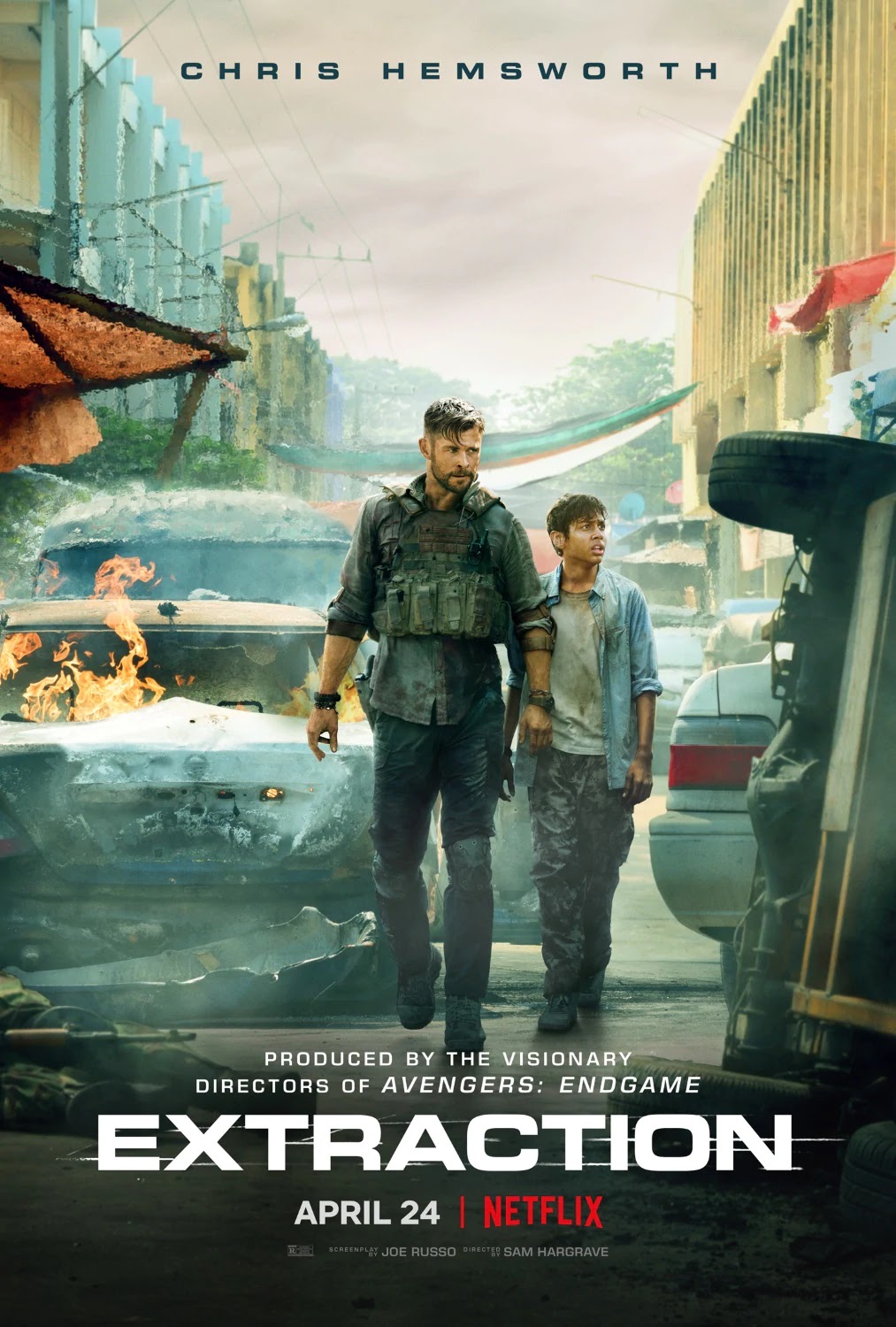
Extraction: A White Man’s Rescue Mission in a Filthy South Asian City


At last Dhaka, the capital of Bangladesh became the subject matter of a Hollywood action movie. After visiting a lot of African countries and Iraq or Afghanistan, the American culture industry found the existence of a small country (big in population size) in South Asia to explore a crime thriller. Though most of the actions of the movie occurred in Dhaka, apart from some plate shots, entire shooting took place in India and Thailand.

When the story of a Hollywood action/thriller movie crosses the border, it portrays a country as the villain’s habitat and a white man as the savior (he would be nearly a superman) of the victim. Under this formula, Dhaka is treated as the habitat of the villain, the drug lord Asif who kidnapped and held Ovi, the son of the drug lord from Mumbai, India for ransom. Tyler Rake (Chris Hemsworth), a black-market mercenary was hired (from Australia) to ‘extract’ the boy from the drug racket in Dhaka. He all alone, remotely backed by his team, rescued the boy and being severely injured, he fell down in the river from the bridge in the outskirt of the city, which was locked down by the law enforcing agencies with the order of the drug lord Asif.

Sunday, July 23, 2017

Bangladeshi Films: Through the Lens of Professor Fahmidul Haq


[Raihana Sayeeda Kamal talks to Dr Fahmidul Haq to know the ins and outs of Bangladeshi films. Dr Fahmidul Haq is a professor of Mass Communication and Journalism department, University of Dhaka]

Transition of Bangladeshi film industry: Bangladeshi film industry evolved around late 1960 to 1970. Transitions took place from 1970 to early 2000. We assume that all 70s films were good but the reality is something different. During then, we didn't have VCR, and satellite connection. Our locals didn't have exposure to western movies. By the exposure to Bollywood and Hollywood movies through VCR and satellite connection, the film industry has faced a blow. Our audience shifted to their productions.

On golden age of films: There is a reason behind dubbing 70s as 'Golden age'. In the early 60s to 80s, most successful films belonged to historical genre or came from local Jatra -- Rupbaan, Sirajuddoula, Behula, Beder Meye Josna etc. People loved them because they had a comprehensive heroic and localised story line which are not being produced these days.  

Decline of golden age: The golden age started to decline in the late 80s or early 90s. During 80s, there was a technological shift and cultural shift. 

Saturday, January 28, 2017

The Ant Story: Modern Man’s Descent into Madness


Mostofa Sarwar Farooki’s The Ant Story explores the issue of contemporary Bangladeshi sexuality from a psychoanalytical perspective. Briefly the narrative is driven by the search to recover a sex tape made by an actress (a celebrity). The attempt to recover the tape allows Farooki to comment on other aspects of contemporary Dhaka City making the film a powerful critique of Bangladesh in the age of consumption

We look at this complex film through the lens of Gerard Genette (1980) and his concept of narrative discourse, emphasising three aspect of narrative, histoire (plot), recite (the voice) and narration (the techniques).

Histoire
An intimate videotape featuring a film actress and her boyfriend in a compromising situation accidentally falls into the hands of an ordinary Bangladeshi youth, Mithu, who is struggling to come to terms with life in the big city. He has insufficient funds to meet his every day needs let alone his desires – for consumer goods that are representative of the move of Bangladesh into the global economy. Consequently Mithu sees possession of the tape in toe ways; as an opportunity to acquire things and as an investment that may bring power. The actress Rima contacted Mithu  to retrieve the sex tape but Mithu, realizing the commercial value of the tape in his possession, becomes a play master and he starts blackmailing Rima.

Under Construction: A Document of Time and Space Under Construction


Under Construction is a film about women made by women. It is also a critique of contemporary Bangladeshi society in two ways. First, the story skillfully weaves together an examination of gender relations in Bangladesh, which is followed with a powerful critique of the exploitation of labour and the underlying political structures governing it in the country. The trope linking these two disparate social phenomena is that of construction. The film looks at and deconstructs how gender is constructed in a conservative, patriarchal society against a backdrop of urban blight caused by the over-construction of dwellings in Dhaka. The latter is of particular importance as the construction industry and the multistory building it produces signify the deep and lasting changes modernity has on shaping contemporary Dhaka. The single storey bungalow is disappearing and the social life it supported is now a thing of history, especially in respect to the role of women. Thus Under Construction has enormous relevance for our understanding of the changing worldview consumer capitalism has brought to Bangladesh. This is made abundantly clear in the manner in which the film deconstructs a classical Bengali play, Tagore’s The Red Oleander.  Roya, the female protagonists seeks to ‘modernise’ the play, which antagonizes some of friends who revere Tagore while a visitor (someone without deep cultural roots in Bengali culture) is attracted to the idea. Thus Under Construction is a multi-layered production that is good to look at but biting in its criticism of contemporary affairs.

Wednesday, August 13, 2014

Policy Supports, Doesn't Control

THE government published a gazette recently on the National Broadcast Policy-2014 despite widespread criticism. The criticism started after the cabinet's approval of the Policy. And the response is not limited only to the stakeholders -- experts on talk shows and general public in the social media are talking about the repressive intentions hidden in the clauses of the policy. It has become a popular issue, and there has been severe criticism similar to the responses to Information and Communication Technology (Amendment) Act, 2013 and Online Media policy (Draft), 2012.  
Those policies and acts were initiated and formulated by the same government in its two consecutive regimes. In all cases, there are similarities in taking policy measures or enacting laws. The government shares the draft online and invites stakeholders and general public to add their views. The final outcome is considered to be repressive and against freedom of expression by the stakeholders and the public. There was only the opportunity for the public to see the draft but there was no mechanism to send feedback there.

Monday, May 12, 2014

First Comprehensive Book on Bangladesh's Media

Eds: Shoesmith  & Gelino

A new book on Bangladeshi media has been published recently. The book is first of its kind that is an anthology of contemporary media of Bangladesh written in English and published from an internationally reputed publishing house (Intellect Books,Bristol/Chicago). The title of the book is Bangladesh's Changing Mediascape edited by Brian Shoesmith and Jude Gelino. I have contributed two chapters in the anthology: 1. 'The Profile and Activity of Citizen Journalists: A Study on Bangla Blog Community' 2. 'Independent Cinema in Bangladesh: Its Roots, Growth, Challenges and Opportunities'. However, the book chapters show that the book tried to cover the diverse areas of changing mediascape of Bangladesh:

Chapter 1: Bangladesh;s Changing Mediascape: An Introduction 1
Brian Shoesmith and Jude William Genilo

Chapter 2: From few to many voices: An overview of Bangladesh's Media
Brian Shoesmith and Shameem Mahmud